AAC Apps, Equipment & Tools
One Page, So Much Language: Building AAC Skills Through Literacy

Vicki Clarke
April 29, 2026


When we talk about AAC, it is easy to drift into the world of isolated practice.
Touch the symbol.
Find the word.
Say “more.”
Answer the question.
Try it again.
There is a place for direct teaching. Our students do need repeated opportunities to learn where words are, how their systems are organized, and how to use those words across the day. But if we are not careful, AAC instruction can become a set of drills that are technically correct but not especially meaningful.
Language grows best when it is connected to something worth talking about.
That is one of the many reasons literacy matters so much in AAC.
When many people hear the word literacy, they think of a student reading a book independently or writing sentences with correct spelling. Those are wonderful goals, but they are not where literacy begins.
At the emergent literacy level, literacy includes:
shared reading
shared writing, often through predictable chart writing
alphabet knowledge
phonological awareness
independent reading
independent writing
At the conventional literacy level, literacy grows into:
working with words, letters, and sounds
guided reading
writing
self-directed reading
All of these areas matter. They are not “extra” activities we get to after communication is established. They are part of how communication develops.
And for students who use AAC, literacy is not optional.
Literacy is the primary way a person can communicate completely autonomously. It is how someone can eventually say anything they want to say, to anyone, at any time, without being limited to the vocabulary someone else selected for them.
That is a big deal.
As a society, we say that we value literacy. We talk about reading and writing as essential life skills. We celebrate children learning to read. We build entire school days around literacy instruction.
But when it comes to students with significant support needs, we often act as though literacy is a prize they have to earn.
First, they need to sit.
First, they need to match.
First, they need to identify pictures.
First, they need to master “functional” skills.
First, they need to prove they are ready.
Of course, self-help skills, ADL skills, participation, safety, and daily routines matter. No one is suggesting we ignore those things.
But literacy is not something we can afford to wait on.
Many of our students need more time, more repetition, more modeling, more access, and more opportunities to learn and use new skills. If we already know that learning may take longer, then the answer is not to delay literacy. The answer is to begin earlier, with better supports, and with the belief that literacy belongs in the educational life of every student from the start.
For preschoolers, early elementary students, older students who are still emergent readers, and students who have never been given enough access, literacy can be one of the most powerful contexts we have for language growth.
One of the most useful shifts we can make is to stop thinking of literacy as only a reading goal and start seeing it as a language-rich communication opportunity.
A single story can give us natural reasons to model and practice:
core vocabulary
fringe vocabulary
emotional language
social comments
questions
opinions
predictions
requests
protests
repeated lines
turn-taking
attention to others
shared enjoyment
That is a lot more meaningful than asking a student to find the same word on a device ten times in a row with no real purpose.
Books give us a shared topic. They give us characters, actions, feelings, problems, surprises, and reasons to keep interacting. They help us move beyond requesting and into the kinds of language that build relationships and thinking.
This is why adapted books and story-based AAC materials can be so useful when they are designed well. They are not just “cute activities.” They can provide repeated, predictable opportunities for students to participate in literacy while also seeing and hearing language modeled on their AAC systems.
Adapted books can be especially helpful when they give students a clear way to participate.
That might include:
repeated lines students can say with AAC
communication boards tied directly to the story
picture choices for commenting or predicting
core words that can be modeled across pages
emotion words connected to characters
simple social messages that sound like real things people say
For example, in a story with a repeated discovery pattern, students might help say:
“Look!”
“What is it?”
“I see it!”
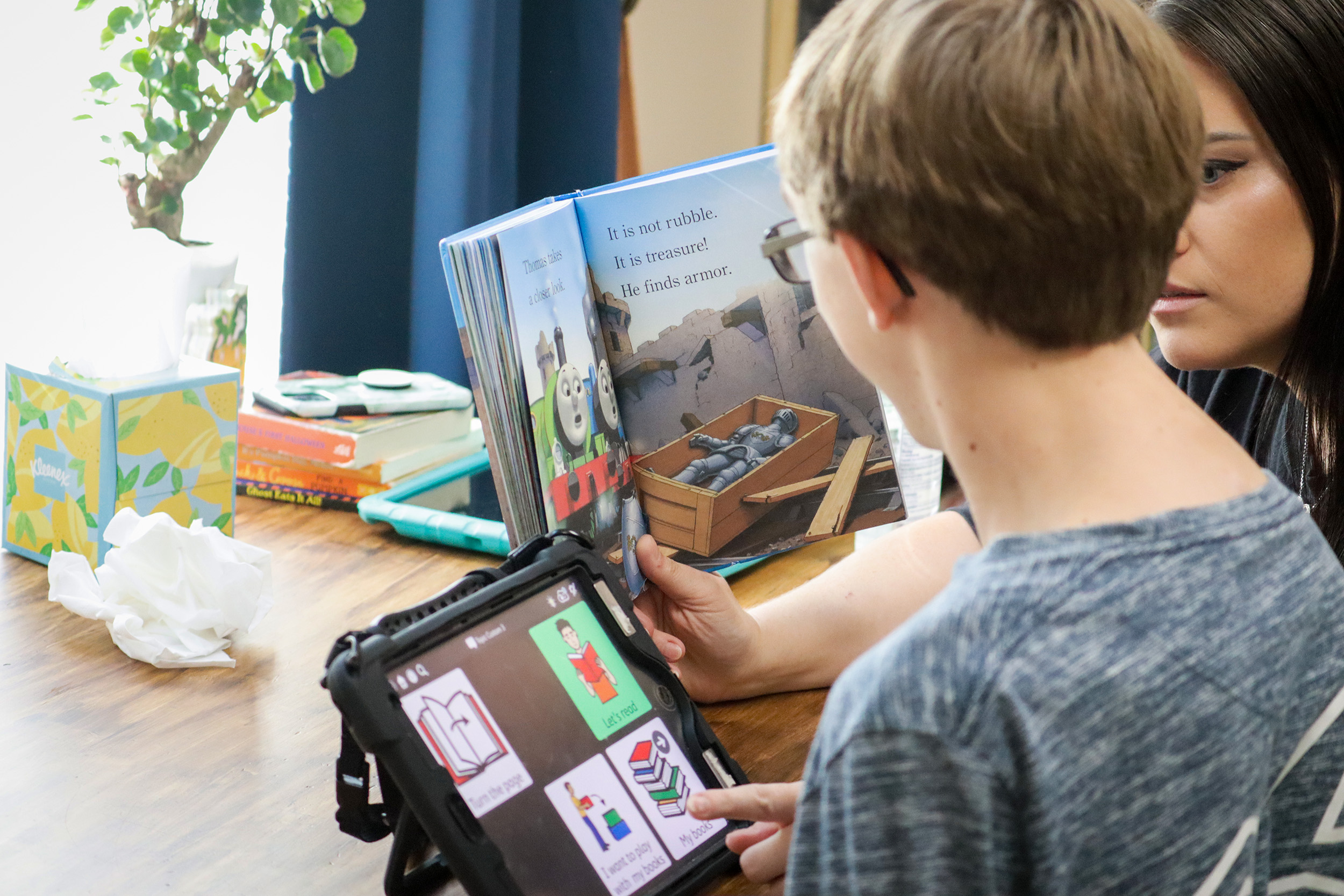
“Turn the page.”
“Not that one!”
“I like it.”
“That’s funny.”
These are not just reading responses. These are communication responses.
The student is joining the group. They are commenting. They are directing attention. They are reacting to the story. They are practicing language in a context that makes sense.And because books are predictable, we can model the same words and phrases again and again without making the activity feel like a drill.
Repeated lines are one of my favorite ways to help AAC users participate in shared reading.
A repeated line gives the student something to anticipate. It gives the communication partner something to model. It gives the group a shared rhythm.
The goal is not to force the student to “say” the line every time. The goal is to create repeated opportunities for the student to see, hear, and possibly use meaningful language.
The adult might model the line on the AAC system, pause expectantly, invite participation, or simply keep reading while making the student part of the interaction.
For some students, participation might look like touching a symbol. For others, it might be looking toward the device, smiling, vocalizing, reaching, turning the page, or using a partner-assisted scanning response.
We can respect the communication the student already uses while also showing another way to say it.
Stories are also one of the easiest places to model emotional language.
Instead of only naming objects on the page, we can talk about how characters feel and why they might feel that way.
“He is mad.”
“She looks scared.”
“I think he is happy.”
“Oh no, that was not good.”
“I don’t like that.”
“That was funny.”
“He wants more.”
“She needs help.”
This kind of language matters because it helps students talk about more than things. It helps them talk about people, feelings, opinions, problems, and relationships.
For many AAC users, emotional language is not modeled often enough. We may focus heavily on requesting, labeling, and following directions. But our students also need access to words that help them say what they think, what they feel, what they notice, and what they care about.
Books give us a natural way to do that.
You do not need a complicated lesson plan to begin.
Open a favorite children’s book to one page and ask yourself:
What could we talk about on this page?
That one page might give you opportunities to model:
Core words: look, go, stop, turn, more, not, like, want, see, help, big, little, good, bad
Social messages: That’s funny. I like it. I don’t like it. Look at that. What happened? Oh no! Your turn. My turn.
Basic activity messages: Turn the page. Read it again. You read. I read. Let me do it. I want more. Stop reading.
Vocabulary from the picture: animals, people, objects, places, actions, colors, sounds
Emotional words: happy, sad, mad, scared, excited, tired, surprised
Thinking and predicting: What will happen next? Where did it go? Who is hiding? Why did he do that? What do you think?
This is the beauty of literacy-based AAC instruction. We are not pulling language out of context and asking the student to perform it. We are embedding language in something shared, meaningful, and repeatable.
Here is your challenge for today.
Pick up one student book. Any book.
Open to one page.
Then create a quick mini-plan:
That is it.
You do not need to model everything. You do not need to ask a question after every sentence. You do not need to require the student to respond perfectly. Just open the book, notice the opportunity, and model language that fits the moment.
Imagine a page where a character is looking for a missing animal.
You might model:
“Look.”
“Where?”
“Not here.”
“I see it!”
“He is worried.”
“Turn the page.”
“What will happen?”
From one page, you have targeted core vocabulary, commenting, negation, emotion words, predicting, and participation in the reading routine. That is rich language instruction. And it feels like reading a book, not completing a drill.
AAC instruction should help students communicate in real life, with real people, about real things. Literacy gives us one of the best contexts for doing that. Through shared reading, shared writing, alphabet work, sound awareness, independent reading, and independent writing, we are not just teaching school skills. We are building access to language, thought, connection, and autonomy.
Our students do not need to wait for literacy. They need access to it now.So today, grab a book. Open to one page. Look closely. There is probably more language there than you think.