AAC in the Community
Representation Matters: Autism Barbie, AAC, and the Power of “Seeing It”

Vicki Clarke
January 15, 2026


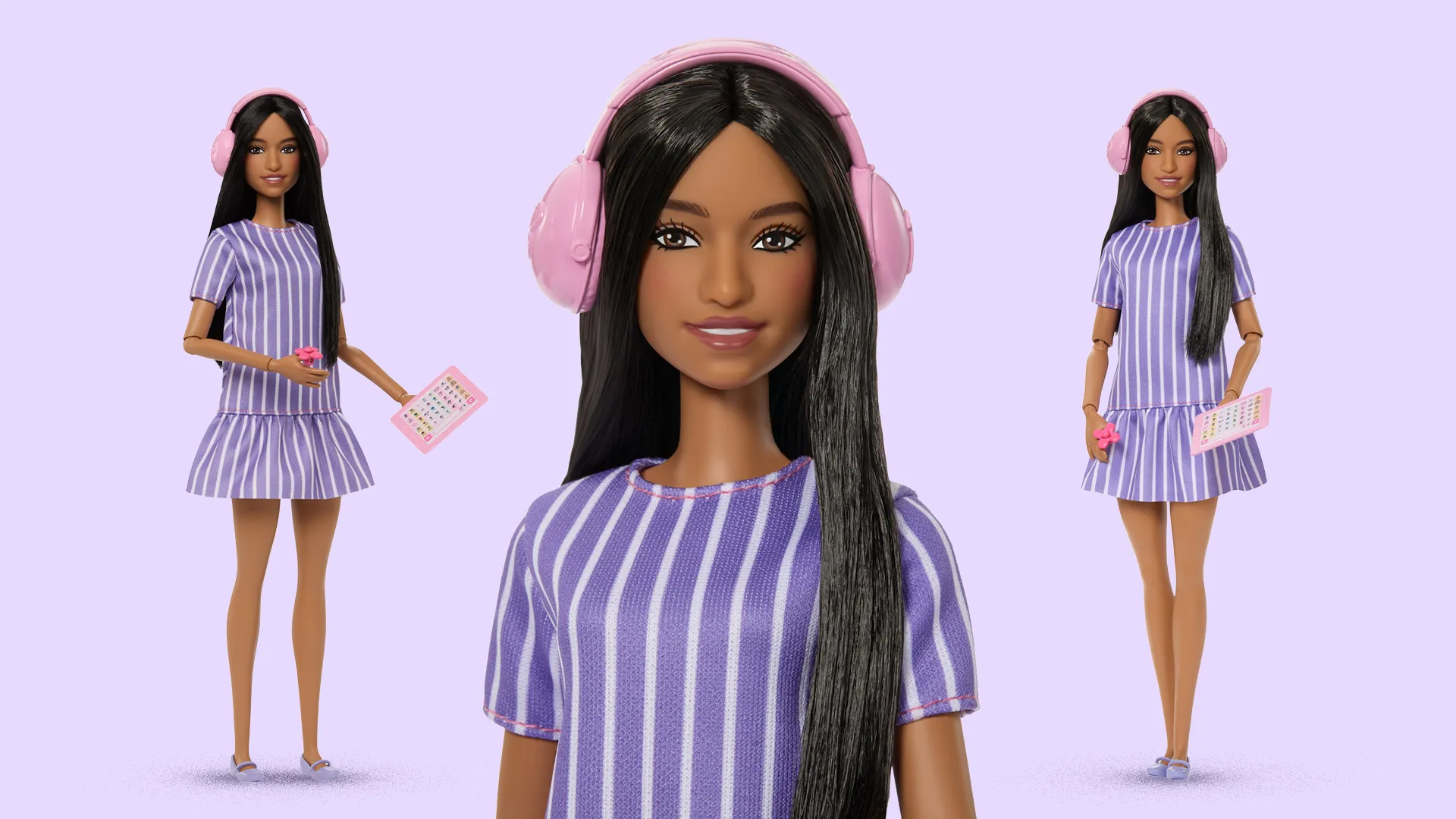
This week, a new Barbie showed up with a detail that feels small until you sit with it: Barbie with Autism is holding an AAC device.
For many AAC users and autistic individuals, that one choice lands in a meaningful way. It quietly communicates, “This belongs in everyday life.” Not in a therapy room. Not only during “communication time.” Not as something unusual that needs to be explained. Just… a normal way people talk.
And that’s exactly why it matters.
Children learn what’s typical by what they see again and again. Who gets included. Who gets to be the main character. Who has a voice in the stories they act out on the living room floor or at the classroom play center.
AAC users don’t get the same volume of models that speaking kids get. Speaking kids are surrounded by speaking communication all day long—at home, at school, on the playground, in stores, on TV, everywhere. AAC users are often surrounded by supportive people, but not necessarily surrounded by people who communicate the same way they do.
That difference matters. Language grows through exposure, repetition, and meaningful use. AAC is no exception.
No, a doll can’t replace real modeling from adults, peers, and AAC mentors. A doll doesn’t teach motor planning or build a system. But a doll can do something that is surprisingly powerful: it can make AAC show up naturally in pretend play.
And pretend play is where kids practice life.
Most of us don’t need a script to play with dolls. We narrate. We invent dialogue. We give characters opinions and complaints and big feelings. We make them negotiate turns, argue over rules, apologize, giggle, and make plans.
So imagine what it means when AAC is part of that world.
Not because the doll “talks,” but because your child can talk for her—using an AAC system—while the story unfolds. It gives you a built-in reason to pick up the device during play and use it the way real people use language: to connect, to direct, to comment, to refuse, to joke, to ask, to repair.
That’s the opportunity here. AAC becomes something you do in the middle of life, not something you do instead of life.
One of my favorite parts of this is how ordinary it can be.
Autism Barbie can do every single thing other Barbies do:
She goes to the playground. She goes shopping. She goes to school. She has friends. She dresses up. She takes care of pets. She teaches. She travels. She gets annoyed. She gets excited. She makes choices. She changes her mind. She has good days and hard days.
And all of that can be “voiced” through AAC in a way that feels playful—not clinical.
Here are a few storylines that tend to work well because they’re familiar and repeatable (which is exactly what helps language stick).
Set up the scene and let it run. Barbie wants a turn on the swing. Someone cuts in line. She needs help climbing. She’s ready to go again. She’s done. She wants to play with someone.
This is where AAC can naturally cover the basics and the social glue:
• greetings (“hi,” “come play”)
• turn-taking (“my turn,” “wait,” “your turn”)
• regulation and boundaries (“stop,” “too much,” “I need space”)
• comments (“funny,” “I like that,” “no thanks”)
Shopping play is gold because it’s full of choices and opinions. Barbie can “look,” “choose,” “change,” “buy,” “not that,” “different,” “too loud,” “break.” There’s a beginning, middle, and end, and the language repeats easily.
School play gives you participation language without making it feel like a lesson. Barbie can answer questions, ask for help, request a break, and talk to friends. She can join a group, disagree politely, and share an idea.
This is the one I hope we lean into the most.
Autistic kids are not projects. AAC users are not “always being worked on.” They’re people who want to belong. Pretend play is a safe place to practice friendship language: inviting, joining, refusing, repairing, and reconnecting.
Barbie can say things like, “Sit with me,” “Please stop,” “That hurt,” “Sorry,” “It’s okay,” “Want to play?”
Dress-up play is perfect for preferences and sensory-related language without making sensory needs the whole story. Barbie can love an outfit, reject it, change her mind, decide something is itchy, or pick the comfy option.
Pets bring out problem-solving and emotion naturally. Barbie can train a pet, celebrate success, handle “uh-oh” moments, and try again. It’s a gentle way to practice persistence and flexible thinking.
If the idea of “using AAC during play” sounds great but also feels like one more thing, here’s a rule that helps keep it realistic:
One message per moment.
You don’t have to narrate every second. Pick the moments that matter—when Barbie starts something, wants something, reacts to something, or connects with someone. Tap one message, then keep playing.
That’s often enough to keep AAC present without turning play into a lesson plan.
AAC users deserve access. They also deserve acceptance—and that includes the quiet, everyday kind of acceptance that happens when people stop treating AAC as unusual.
When a widely recognized toy includes AAC in the story of childhood, it helps normalize what many AAC users are working toward all along: being understood and included without fanfare.
It also gives families, educators, and peers an easy opening. A child notices the device and asks about it. A sibling includes it in play. A classmate becomes curious in a positive way. Suddenly, AAC is not “that thing over there.” It’s part of the world.
And that’s a shift worth celebrating.