Speech Therapy
Evaluating Spanish-English Bilingual Students: Practical Guidance for SLPs and School Teams

Melissa Barbieri
November 11, 2026


By Melissa Barbieri, Bilingual SLP, DTA Schools
Serving as Lead SLP in Rome City Schools, Rome, Georgia
Introduction by Vicki Clarke
If you’re an SLP preparing to evaluate a Spanish-English bilingual student, you may be wondering where to begin—especially if you don’t speak Spanish yourself. This post is for you, and for the educators and other professionals working alongside you to support bilingual students.
Melissa Barbieri, a bilingual SLP with DTA Schools who serves as the Lead SLP in Rome City Schools in Rome, Georgia, shares practical guidance drawn from her experience. From understanding a student’s language background to working with interpreters and choosing assessment approaches, Melissa offers a starting point for thoughtful evaluations that consider both language and culture.
* * *
So you have a bilingual evaluation on your schedule, but all of a sudden you realize graduate school managed to basically skip the part where you have to work with the other 20% (~68 million) people in the United States that identify as Hispanic.
In fact, you’ve probably already realized a large portion of your caseload comes from a Spanish-speaking background, and unless you are part of the 5.1% of SLPs who speaks Spanish (according to ASHA), this may seem daunting. And while in a perfect world, a bilingual SLP would complete evaluations for a bilingual student…a 5.1% SLP to 20% student ratio makes that seem unlikely. That means despite our cultural backgrounds, it is our duty to meet our students where they’re at!
But do not fret – as a bilingual SLP, I am here to share some ideas and recommendations that will hopefully help you along the way.
All that being said, let’s start at the beginning. We know our formal, standardized assessments are generally not norm-referenced for a more diverse population. That means we can’t base our recommendation/diagnosis on a formal assessment. If you’re evaluating bilingual students (and for the purpose of this particular blog post, Spanish/English bilingual students), your assessments must have a combination of caregiver/teacher reports, language samples, subtests/informal assessments, and dynamic assessment. Some of these areas may overlap, but the idea is to cast your net far and wide rather than focusing on using one standardized assessment.
Before starting any testing, you also need to determine their language proficiency. This part can get a little tricky, and I’d definitely recommend the help of a human interpreter for this (even if it’s a Spanish-speaking co-worker, though I’ll get into interpreters later). Language proficiency can be impacted by the environment/community language, parental level of education and socio-economic status, and even personal motivation (from parents and the student themselves). In addition to that, if your student is speaking Spanish at home, their vocabulary is still generally limited to household words/topics, whereas at school they would have access to a much more expansive vocabulary.
Growing up in South Florida I have been able to witness this first-hand. Here’s a breakdown of what I have personally observed in a largely Hispanic/bilingual community:
This is not comprehensive nor is it an exact representation of language proficiency, but it may provide a better picture of what bilingual homes may look like. I also like to ask students what language they feel more comfortable in. What language do they like to read or watch TV in? If your student falls within the categories 2-4, it is very possible that they will perform better in English testing than in Spanish (especially if that test is the CELF Spanish, which is very difficult).
Great – now you’ve identified your student speaks Spanish and you are almost ready to start testing! But, there’s another caveat. There are 21 countries that consider Spanish their official language (compared to 6 in English). This means that Spanish vocabulary, grammar, etc., can change drastically across countries, cultures, and regions. Just as a small example: there are 14 words that mean “bus” and 5 different ways to say “you” (depending on your audience and culture). This is why considering your student’s cultural background beyond “Hispanic” is very important.
We have finally made it to testing! The best-case scenario is that you will have a trained interpreter at your evaluation. While Google Translate and AI has gotten better, it still cannot accurately translate the nuances of language and culture. This is especially difficult if your student is code-switching because it is not randomly throwing together words from 2 languages. You can only “switch” at points in a sentence where it respects the grammar structures of both languages. For example, “I want an auto red”: Even though in Spanish the noun goes before the adjective which I did in this sentence, it doesn’t follow English grammar which is why this is not proper code switching and would be a red flag.
It's also important to meet with your interpreter beforehand to prep them and explain what you’ll need them to do. After the evaluation, it is also vital to debrief, review the results, and determine if any cultural/linguistic factors could have been at play.
Here are some standardized tests that do have options in Spanish:
Informal testing is equally as important. Here are some suggestions:
If you are using tests which have not been normed on bilingual populations, you have to read results with caution. In fact, if you fear the standard scores will lead to bias, it may be best to omit scores.
We also know that a language disorder and a language difference are not the same, but what does that mean? For example, the articles “the” and “a” and prepositions “through, for, of” were often to be in error for Spanish-English speakers. Those errors aren’t “language disorders” but translation mistakes from their L1 to L2 as they are learning a new language.
Here’s a list of other frequent “errors” for Spanish L1 individuals speaking English as a L2:

The same goes for articulation errors. If a particular sound doesn’t exist in someone’s phonemic library, it may be very difficult for them to produce it, and not because it’s a disorder, but because they haven’t been exposed to it. If you’ve ever tried learning a new language with very different sounds than you’re used to, then you understand! Think of the /r/ sound in French, or the different tones in Chinese. Here is a list of Spanish and English consonants:
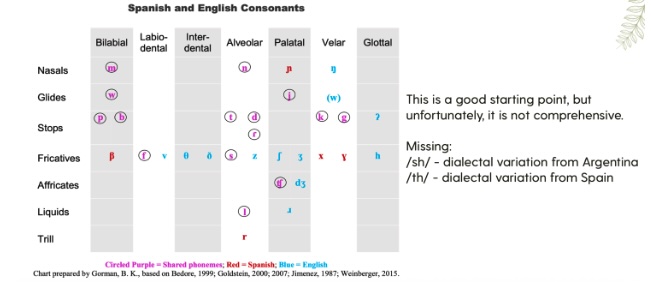
Below are even more differences. While they couldn’t all be listed here, the Literature Review “DIALECTAL VARIATIONS IN SPANISH PHONOLOGY” by Silvia Martinez, EdD, CAS, CCC-SLP at Howard University has proven to be a gold mine!
While that's all I have to share for now, there's definitely more learning to do! Even though testing our bilingual students might seem like a daunting task, the moral of this story is that we shouldn’t be scared but rather use this opportunity to learn more about their culture. Together, we can help bridge the gap of communication equity for our bilingual students and their families (and become better SLPs along the way!).


