AAC Resources
October Is AAC Awareness Month: Making Communication Easier to Support

Vicki Clarke
September 30, 2026


Every October, we celebrate AAC Awareness Month—a month devoted to increasing awareness, acceptance, inclusion, and opportunity for people who use augmentative and alternative communication (AAC).
For us at DTA Schools, it is also a good time to think about something very practical:
How can we make it easier for the people around AAC users to support communication every day?
Because having access to an AAC system is important. But having a device, communication board, or communication book is only the beginning.
International AAC Awareness Month was established in October 2007 by the LEAD Project Committee of the International Society for Augmentative and Alternative Communication (ISAAC). Thirteen countries participated in that first year, and the movement has continued to grow around the world. ISAAC
The original purpose remains important today: to increase awareness of AAC and help the public understand the many different ways people communicate. ISAAC
That includes high-tech speech-generating devices, but AAC is much broader than technology. Communication may include speech, gestures, facial expressions, signs, pictures, communication boards, writing, spelling, devices—and combinations of all of these.
AAC Awareness Month gives us an opportunity to recognize and celebrate all of those different communicators.
But awareness is only the first step.
One of the biggest challenges we see isn't simply getting AAC into a student's hands. It's helping the people around that student know what to do next.
Teachers are teaching. Paraeducators are supporting multiple students. SLPs have large caseloads. Families are trying to incorporate AAC into everything else that happens at home.
AAC implementation can feel like one more thing that someone has to learn, prepare, print, create, or plan.
We want to reduce that burden.
That's really the idea behind our DTA Schools resources, materials, and professional learning: take what we know about good AAC implementation and make it practical enough to actually use on Monday morning.
We don't want AAC to be something that comes out only during "AAC time" or a speech therapy session.
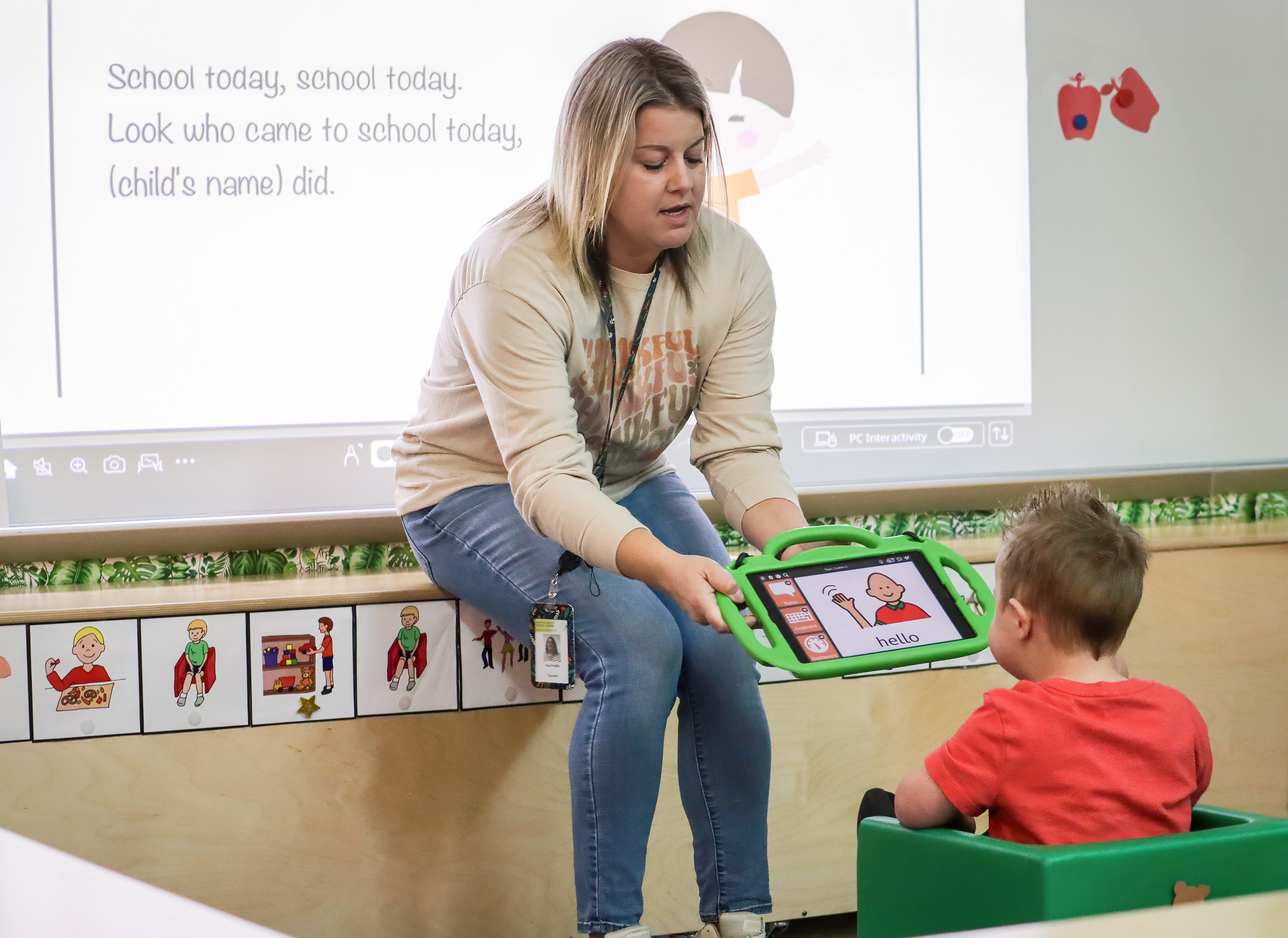
Students need communication while they're eating lunch, doing a science experiment, reading a book, getting dressed, going to the bathroom, working on academics, playing with friends, asking for help, protesting, making choices, telling us something funny, and participating in their classroom.
That's why so many of our materials are built around daily routines and real activities.
The goal is to give teachers, paraeducators, SLPs, and families something they can open and use right away—with the communication supports already incorporated.
And while we want the materials to be simple, we don't want "simple" to mean without substance.
Our work is informed by AAC research and effective implementation practices while also connecting to broader expectations for special education instruction. The Council for Exceptional Children, for example, emphasizes meaningful and individualized learning, access to general and specialized curricula, active student engagement, explicit instruction, effective routines, and collaboration with families, paraeducators, and other professionals. CEC
Those principles fit beautifully with what good AAC implementation should look like.
That's the goal behind what we create
Whether we're developing our Resources & Materials website, creating a new activity, or providing professional learning to a school team, we keep coming back to the same goals:
We don't expect every adult supporting an AAC user to become an AAC specialist.
We want to give them enough support that they can say, "I can do this."Celebrating AAC Awareness Month with 25% and 20% off
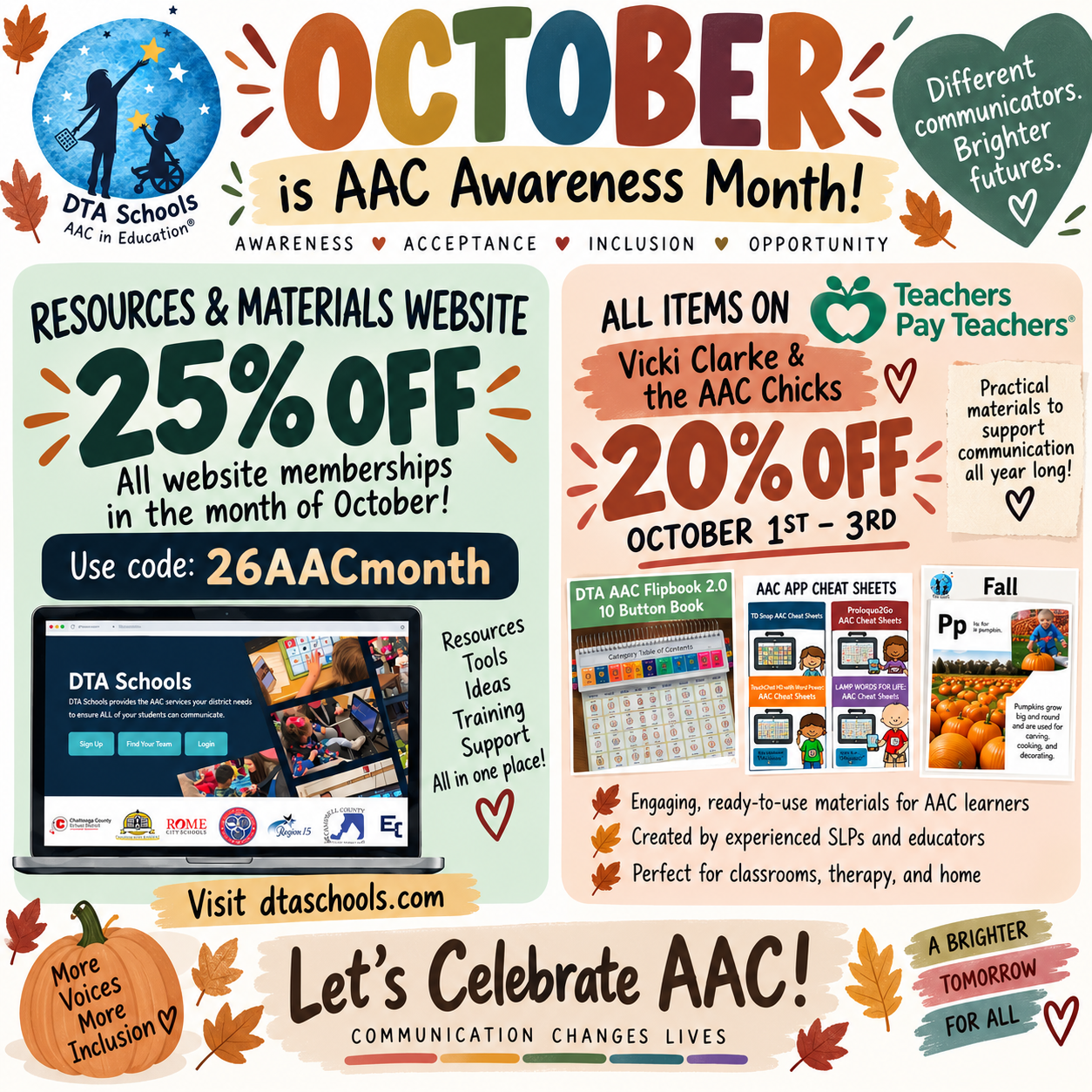
This October, we're celebrating AAC Awareness Month by making our materials a little easier to access.
Use code 26AACmonth.
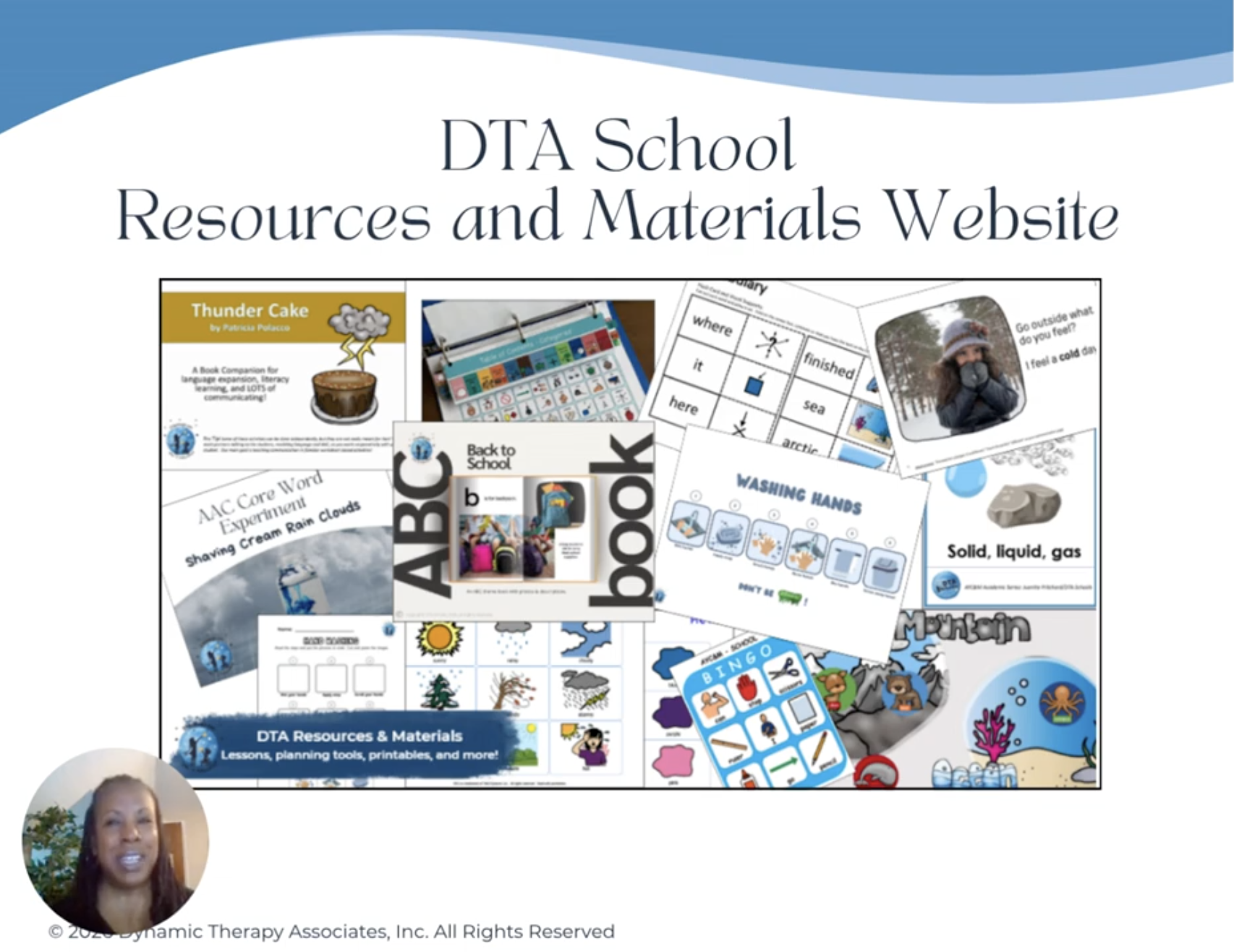
The website includes ready-to-use communication supports, activities, instructional materials, ideas, and training resources designed to help teams incorporate communication across the school day.
Our TpT materials are designed with the same goal: practical resources that can move directly from your computer into your classroom, therapy session, or home routine.
Visit Vicki Clarke & the AAC Chicks on Teachers Pay Teachers
AAC Awareness Month certainly gives us a reason to talk about AAC.
But ultimately, our goal isn't simply AAC awareness.
It's creating classrooms, homes, and communities where different ways of communicating are expected, respected, supported, and available throughout the day.
And sometimes making that happen starts with something very simple: giving the people who support AAC users the tools they need to make communication a little easier today.