AAC in the Community
AAC Happens Everywhere: Why Everyday Moments Matter More Than “Table Time”

Stephanie Ekis
September 22, 2026


By Maranda Murphy and Stephanie Ekis
When we think about helping our children learn to use Augmentative and Alternative Communication (AAC) devices, it’s easy to picture a structured activity: sitting at the table, focusing hard, and practicing words. But that’s not how communication develops for most children, and it’s not how AAC learning works best either.
Language develops from thousands of tiny interactions woven throughout the day: greetings, choices, play, routines, and shared moments. AAC learning thrives the same way.
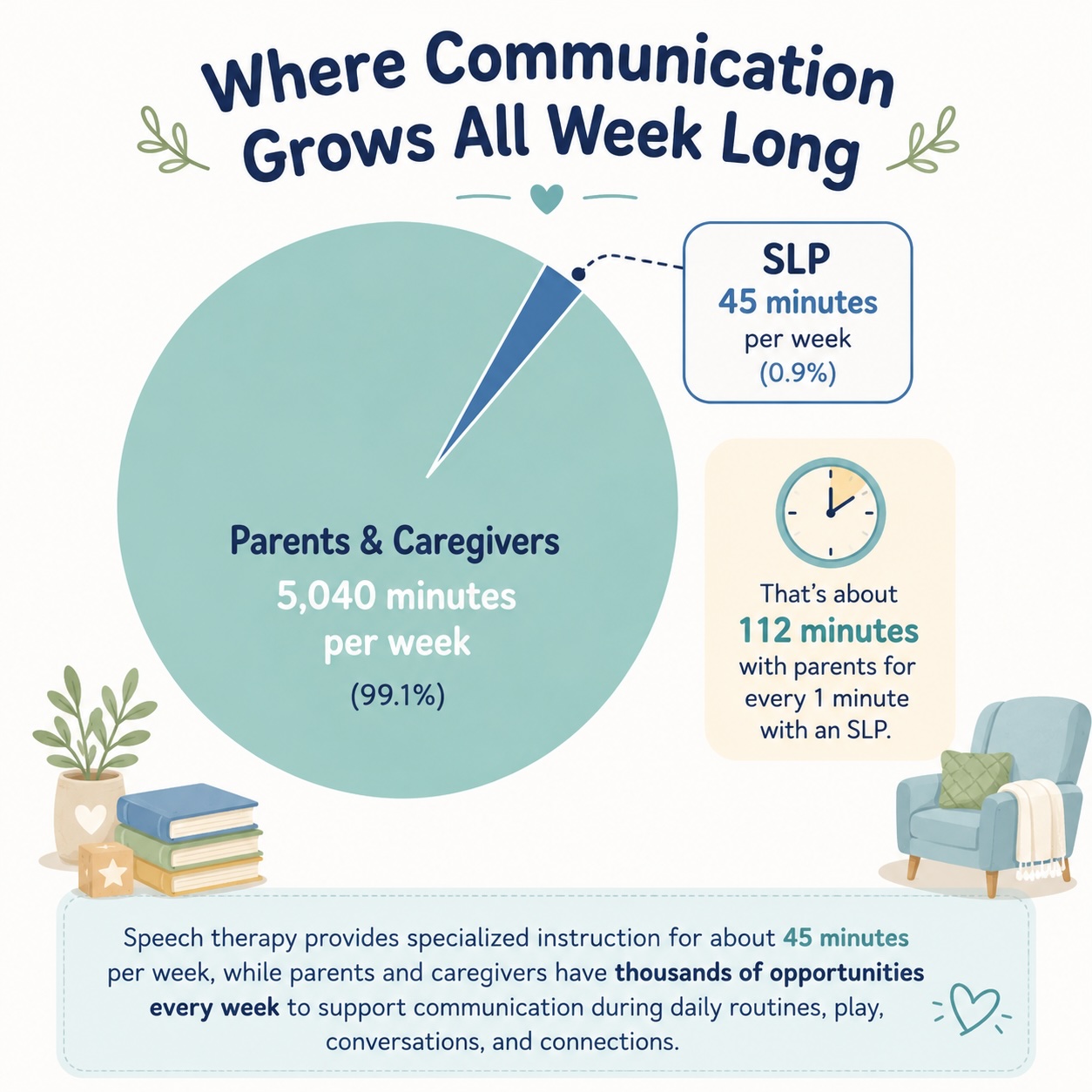
In fact, Jane Korsten, SLP, highlights just how much language exposure happens during everyday life. The average 18-month-old has been exposed to approximately 4,380 hours of oral language, based on about 8 hours of language exposure per day from birth. In comparison, a child who uses AAC and receives speech-language therapy twice a week for 20–30 minutes would take approximately 84 years to receive the same amount of language exposure through their AAC system.
This comparison is powerful, and it’s exactly why AAC cannot be limited to therapy sessions. Your child needs communication input throughout the day, in the places where life actually happens.
AAC doesn’t need to be a “sit down and work” activity. In fact, some of the most meaningful learning happens in the tiny interactions that fill your day:
Every one of these moments is an opportunity to model language on your child’s AAC system. When you use the device by showing words, exploring buttons, and modeling phrases, you’re giving your child the input they need to learn how communication works.
Your child depends on the people around them to show them how to communicate. AAC becomes more successful when the people in your child’s everyday environment model and use the AAC system alongside them.
These strategies are easy, natural, and fit into real life.
Pick a single core word (like go, help, open, more, or stop) and model it whenever it fits. No pressure. No expectations. Just give your child opportunities to see and hear the word in everyday moments.
AAC works best when it’s available everywhere: the kitchen, the car, the bedroom, the backyard. If your child doesn’t have access to their AAC system, they may not have access to their voice.
Say what you are doing:
Kids learn by watching you use their system. Modeling does not always have to be directed toward the child. Sometimes, simply showing them how you communicate using AAC is enough.
Play is language. Model words like again, turn, big, go, fun, my, and your while playing with toys, games, or pretend scenarios.
You don’t have to stop the fun to “practice AAC.” Instead, let AAC become part of the fun.
Are siblings curious about the AAC device? That curiosity can be a great opportunity to get them involved! Let them model words, interact with the device, and create natural opportunities for communication during everyday activities. Siblings can be some of the best communication partners as long as the AAC user is comfortable and is not showing signs of frustration or asking for their device back.
AAC learning isn’t about perfection. It’s about exposure, connection, and shared experiences. When you model language during everyday routines, you’re giving your child more opportunities to see and experience how communication works.
The goal isn't to create more “therapy time” at home. It’s to recognize that home is already full of communication opportunities.
You don’t need to create hundreds of extra activities. You just need to look at the moments that are already happening: breakfast, getting dressed, playing, running errands, eating snacks, reading books, and getting ready for bed.
You don’t need 84 years. You just need everyday moments, and you already have those.