Language & Communication Development
Before We Can Teach Anything Else: A Communication Lesson from Project Hail Mary

Vicki Clarke
September 14, 2026


Spoiler alert: This post discusses parts of Project Hail Mary, including the relationship between the two main characters.
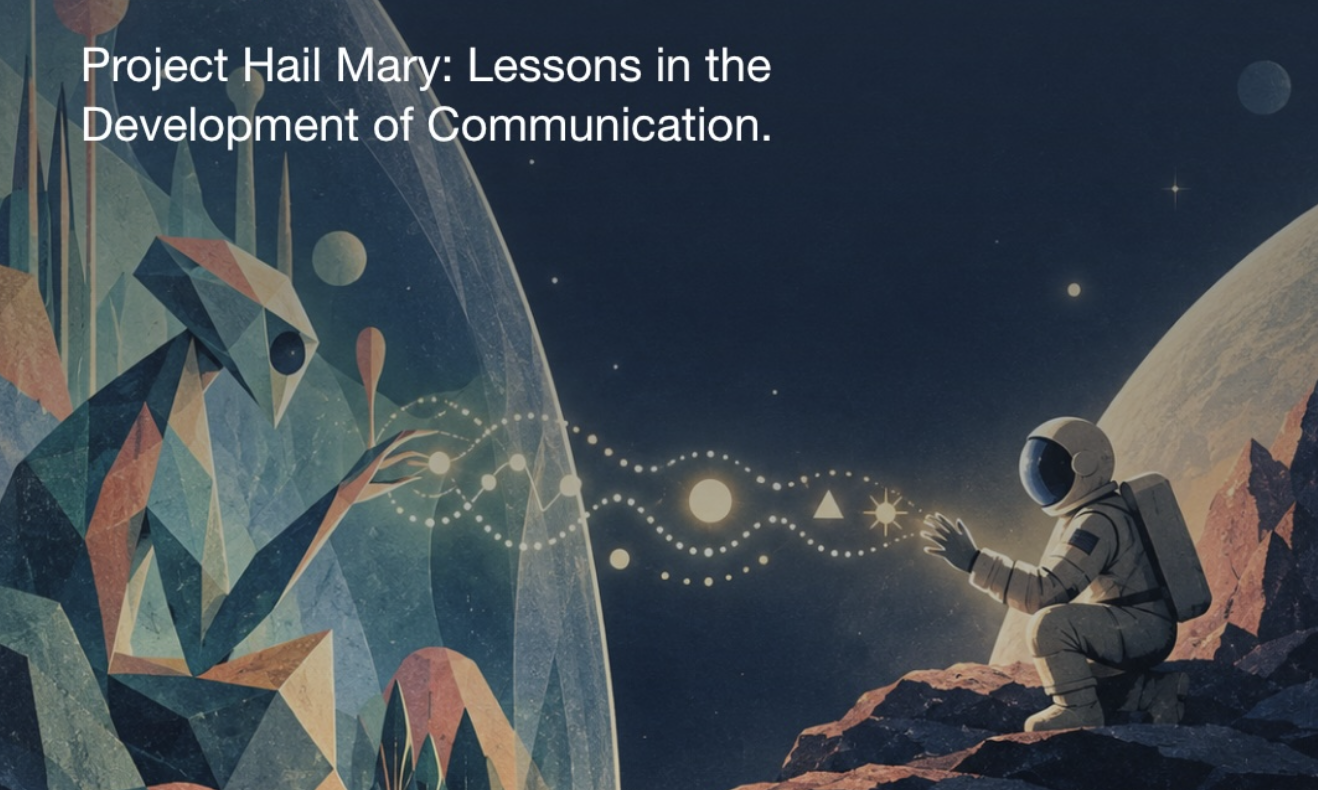
I watched Project Hail Mary recently, and because I spend most of my days thinking about communication, I found myself watching it through that lens.
When Ryland Grace encounters Rocky, an intelligent alien from another world, they are both highly capable. They both have knowledge and skills. And they both have a very important problem to solve.
But initially, none of that matters very much.
They can’t communicate.
And before they can accomplish anything together, they have to figure that out.
Before Grace and Rocky could learn to communicate, something even more basic had to happen.
They had to recognize that communication between them was possible.
They had to look at the actions and sounds of this completely unfamiliar being and consider that they might be intentional. That there might be meaning there. That the other being might have something to say.
That feels particularly important when I think about the students we support.
Sometimes the first barrier isn’t a lack of words, symbols, or the right AAC system. Sometimes the people around a child haven’t yet recognized the child’s attempts to communicate—or aren’t yet confident that the child can become a more effective communicator.
A movement may be interpreted as random. A sound may not be recognized as meaningful. Turning away may be seen only as behavior rather than potentially communicating no, stop, or I need a break.
And when communication isn’t expected, we may wait less, offer fewer opportunities, and model less language.
Before we can teach a child to communicate, we have to believe there is a communicator there.
That doesn’t mean assigning meaning to every movement, sound, or behavior. It means beginning with the expectation that this person has something to say—and accepting our responsibility as communication partners to help build a way to say it.
That is where Grace and Rocky begin.
Grace and Rocky start with things that are concrete.
Objects. Numbers. Actions. Things they can both see and experience.
They watch each other. They repeat things. They gesture. They use objects. Essentially, they begin building a shared dictionary.
This is what I call this.
What do you call it?
When you make that sound, this is what you mean.
Eventually, they label themselves.
Grace.
Rocky.
Now they aren’t just talking about things. They are talking about you and me.
And once they have a little shared language, they use it to learn more language.
That’s worth thinking about with beginning communicators and students learning AAC. We don’t have to wait until someone “knows” a communication system before we start using it together.
We build shared meaning by communicating.
Grace and Rocky have another problem: their bodies are very different. They don’t breathe the same atmosphere, so their new language quickly becomes practical. They need to figure out how to safely exist and work in the same space.
That part felt very familiar to me.
Think about some of the earliest and most important things our students may need to say:
Help me. Stop. I don’t want that. Wait. Something hurts. I need something different.
So much of communication is connected to taking care of our bodies, maintaining our safety, and having some control over what happens to us.
Eating. Drinking. Toileting. Positioning. Moving. Resting. Getting help. Refusing. Choosing.
We sometimes call these “basic” communication skills. But there is nothing unimportant about them.
They are foundational because they matter so much.
Something else happens between Grace and Rocky.
They become friends.
They joke. They worry about each other. They disagree. They misunderstand each other and repair those misunderstandings.
Their communication is no longer just about getting something done.
That’s important too.
When we’re teaching students with significant disabilities, it can be easy to focus heavily on requesting and responding:
What do you want? Answer the question. Tell me what you need.
But communication is also how we say:
Look at that. That’s funny. I like you. I don’t agree. Listen to this. I missed you.
Communication is how we connect with other people. That’s a lot of what makes communication worth having.
Eventually Grace and Rocky need to solve a much bigger problem, and neither has everything needed to solve it alone.
Grace knows things Rocky doesn’t know.
Rocky knows things Grace doesn’t know.
But now they can ask questions, exchange information, teach each other, compare ideas, and solve problems together.
What one person knows becomes available to the other person.
That’s where this story really connects with education for me.
Communication isn’t simply another skill our students need to learn.
Communication gives them access to learning.
It gives them a way to show us what they know, learn from other people, ask questions, solve problems, and contribute their own ideas.
Grace and Rocky use what works.
Sounds. Speech. Gestures. Objects. Demonstrations. Visual information. Context.
That’s an important distinction when we think about AAC.
The device isn’t the destination. The communication board isn’t the destination. The symbols aren’t the destination.
Those are tools.
The goal is being able to tell someone what you need, share what you know, ask a question, refuse, joke, participate, learn, connect, and have some control over what happens in your own life.
That’s what stayed with me after watching Project Hail Mary.
Grace and Rocky have an enormous problem to solve. But first, they have to recognize that the other is a communicator.
Then they build shared meaning.
They use that shared language to meet immediate needs, build a relationship, exchange knowledge, and eventually tackle a problem neither could solve alone.
We sometimes talk about communication as though it is one more thing we need to teach our students.
I think we have that backwards.
Communication is the thing that allows us to teach almost everything else.
And perhaps there is something even more foundational than that:
We have to presume that there is a communicator there.
Our students have things to learn, bodies to take care of, opinions to share, relationships to build, problems to solve, and a world they deserve to participate in.
It starts with someone looking at them and believing:
You have something to say. Let’s figure out how we can understand each other.